Have you ever looked into the eyes of your dog as it gazes at you?
Inside those clear, gentle eyes lies something strange. A kind of trust that you would never find in a wild wolf – something that exists only in dogs. Scientists call it “human-directed gaze,” but we simply call it love.
But is this love really just an emotion?
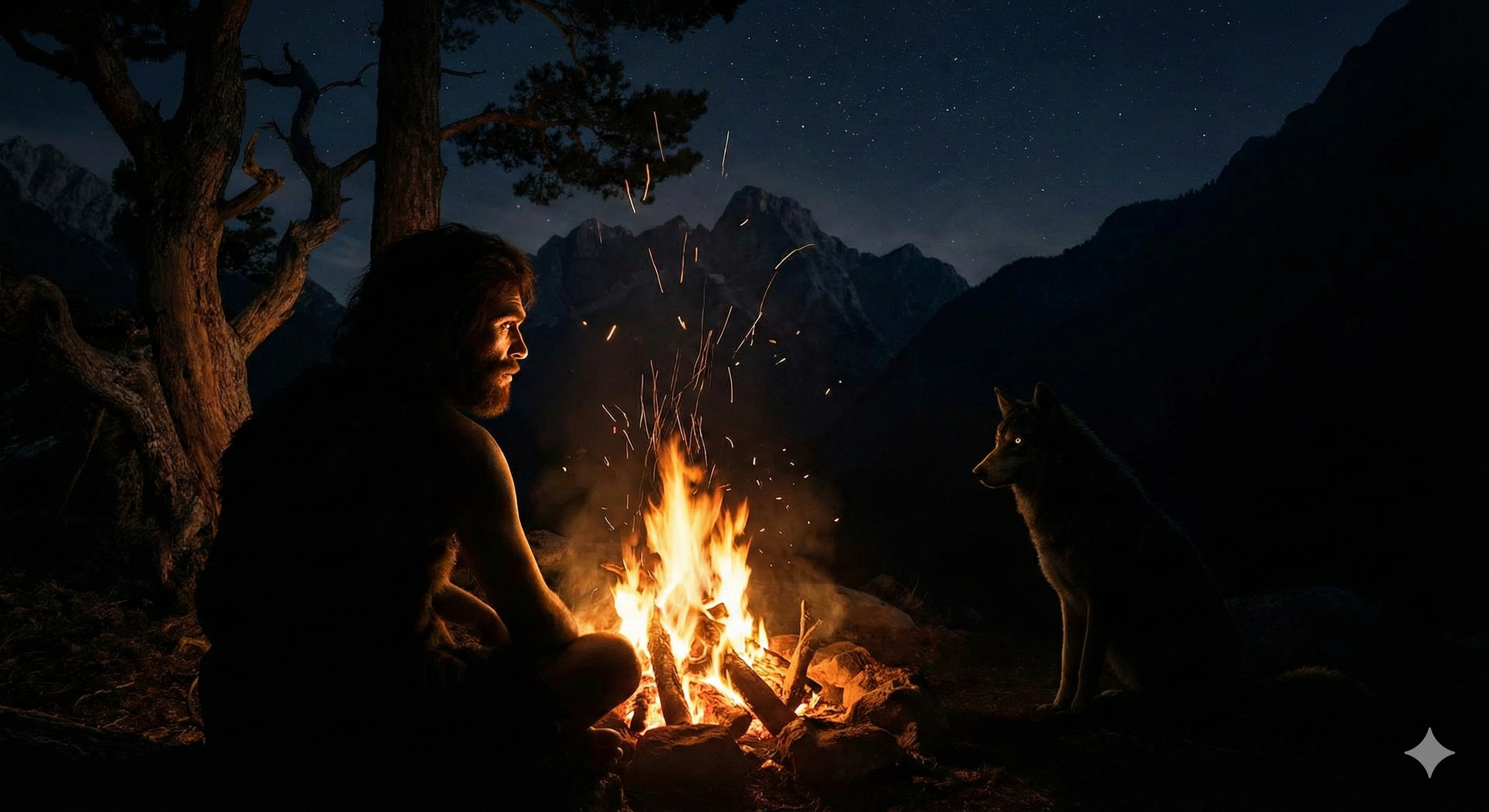
1. What Happened by the Campfire
Let us rewind 30,000 years. Actually, no one knows exactly when it was. Perhaps 15,000 years ago, or maybe 40,000.
What matters is that something began on that night.
A wolf was prowling around the edges of a human campfire. It was hungry. The bones the humans had discarded smelled of meat. But whenever it drew close, stones came flying.
Then one day, one wolf was different.
It neither approached nor fled. It kept its distance. It ate the bones the humans tossed. When night fell, it growled into the darkness. It was a signal – something was coming. The humans raised their spears. The beast fled.
The next morning, that wolf came back.
Was this a contract? Or merely coincidence?
2. What Ten Thousand Winters Carved
A single transaction is a coincidence. But repeat it ten thousand times, and it becomes a pattern.
The oldest dog remains that archaeologists have found date back 15,000 years. The dog was buried alongside a human. It was wearing a necklace.
What happened in the time between?
Geneticists analyzed dog DNA. And they discovered something – genetic mutations that wolves do not have.
Changes in the oxytocin receptor.
This is the hormone released when a human looks at a baby or gazes at someone they love. Dogs release it when they look at humans. Wolves do not.
Over 15,000 years – perhaps 30,000 – a process of selection was taking place.
3. The Law of Selection
Imagine this.
Some wolves attacked humans. They were killed. Some wolves ran away. They starved to death. Some wolves drew close but ignored the signals. They were driven off.
Only those wolves that could read human eyes, maintain the right distance, and respond to signals survived beside the warm fire.
Their offspring inherited the same traits. With each passing generation, “human-friendly” characteristics grew stronger.
Science calls this artificial selection.
But were humans really the only ones choosing?
The wolves chose too. They chose the knowledge that “staying with these strange two-legged creatures means more food, more warmth, and a longer life.”
Both sides chose. They chose each other.
4. So, Is This Love?
In 2015, Japanese scientists conducted an experiment.
They had dogs and their owners gaze into each other’s eyes. Then they drew blood samples.
The results were astonishing.
Oxytocin levels surged in both the dogs and the humans.
To the same level as when a mother holds her baby.
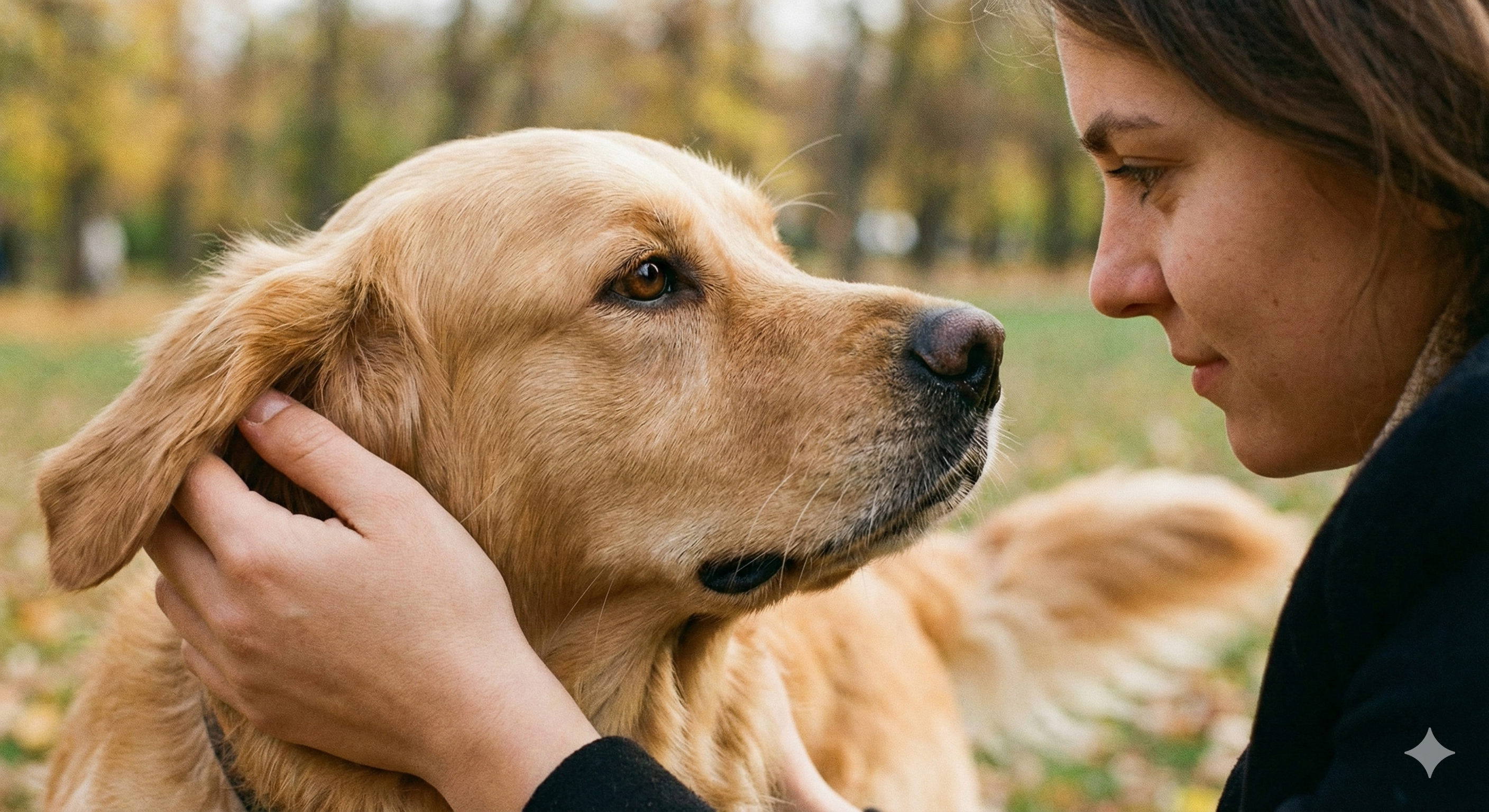
When they repeated the experiment with wolves? Nothing changed.
So here is the question.
What the dog feels when it looks at you, what you feel when you look at the dog…
Is it merely a chemical reaction engineered by genes?
Or is it a real emotion forged over 15,000 years?
Or could it be both?
5. What We Can Learn
The reason the story of humans and dogs is special is that it is the only case of mutual evolution that crosses the boundary between species.
We domesticated cattle. But cattle do not love us. We took in cats. But cats can leave whenever they please.
Only dogs changed alongside us.
Their skull shape changed. (Shorter and rounder.) Their ears drooped. (A sign of reduced aggression.) Their eyes learned how to look at us.
We changed too.
Humans who live with dogs have lower blood pressure. They experience less loneliness. They live longer.
Each saved the other.
6. So Is This a Promise?
I do not know.
But I do know this.
Whatever began on that cold night 30,000 years ago, beside a campfire, continues to this day.
Whether it was a contract, symbiosis, love, or something we have not yet found a name for…
When your dog looks at you, you are gazing upon 15,000 years of trust.
In that gaze lives a certainty: “I know you will not abandon me.”
And you know it too. When you leave, that dog will wait.
Tonight, stroke your dog.
The heartbeat you feel beneath that warm fur is proof of something that has crossed ten thousand winters.
What would you call it?
This essay was written as a reinterpretation after watching a video from the YouTube channel “Voyage of Time.”