Every spring, solar farms in South Korea’s Jeonnam province receive a bizarre order: “Stop generating.” The government told them to install panels, and now it tells them to throw the electricity away. It is called curtailment. In 2022, it happened 77 times — and the number has been climbing fast since. Tens of billions of won worth of electricity vanish into thin air every year. The same story plays out wherever grids cannot absorb all the solar power being produced, from California to Queensland.
Why not just store the surplus? Lithium-ion ESS (Energy Storage Systems) caught fire more than 30 times in South Korea between 2017 and 2019. Residents now oppose any project with “ESS” in the name. Insurance premiums have skyrocketed, and business cases have collapsed.
Here is the problem laid out plainly. Electricity is going to waste. The batteries meant to store it catch fire. Farmers are crushed by heating bills every winter. And fertilizer is almost entirely imported. Four separate crises — sitting in the same room, not talking to each other.
But what if a single battery could solve all four at once?
The Answer Edison Left Behind 120 Years Ago
In 1901, Thomas Edison patented a battery. The iron-nickel battery. Nickel at the cathode, iron at the anode, potassium hydroxide solution as the electrolyte. Water-based.
Line it up against lithium-ion and the contrast is stark.
| Iron-Nickel | Lithium-Ion | |
|---|---|---|
| Fire risk | Zero. Aqueous electrolyte; thermal runaway physically impossible | Organic electrolyte; thermal runaway possible |
| Lifespan | 30–50 years. Electrodes do not degrade | 10–15 years. Replacement mandatory |
| Overcharge | Welcome. Produces hydrogen | Explosion risk |
| Over-discharge | Tolerant | Cell damage |
| BMS | Not needed. Self-regulating | Essential. Failure is catastrophic |
| 30-year total cost | Zero replacements | 2–3 replacements |
The downside? Heavy and low energy density. Useless for electric vehicles. But for stationary, large-scale ESS? Weight is irrelevant, and rural land is plentiful. The disadvantages disappear.
In February 2026, a UCLA research team announced that an iron-nickel battery built with a nanocluster process achieved multi-second charging and 12,000 cycles (over 30 years). The researchers described it as “mixing common materials and heating them.” A 120-year-old technology is still evolving.
When a Battery Becomes a Hydrogen Factory
Here is where the story takes a turn.
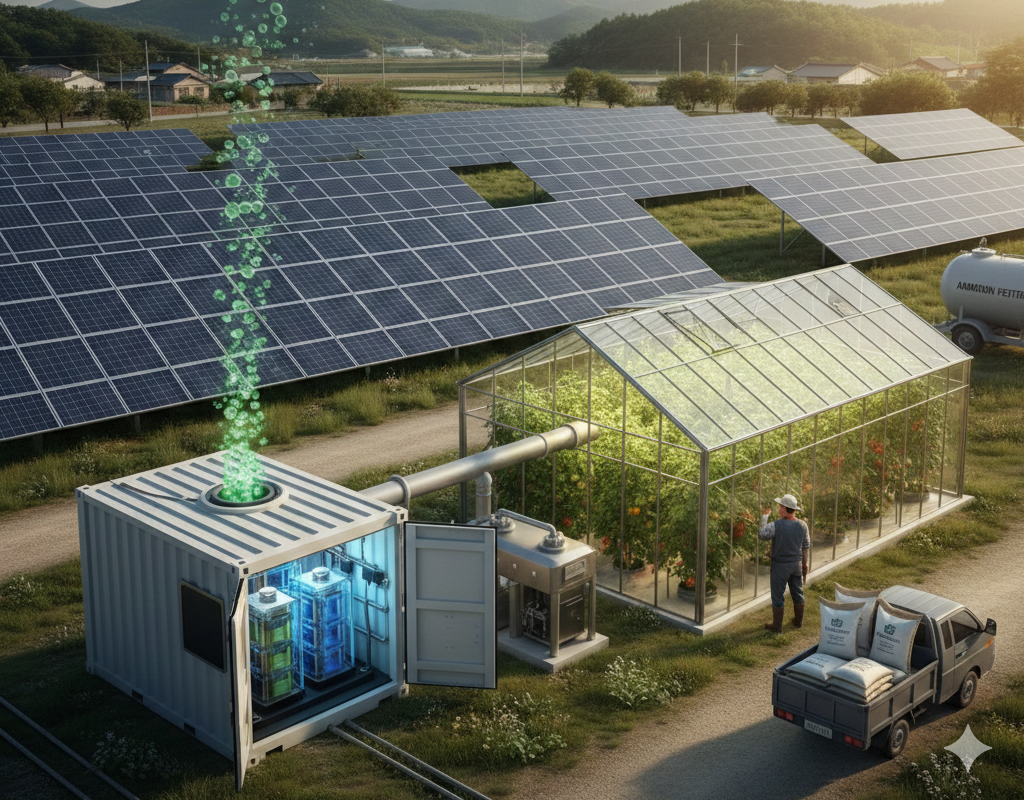
Researchers at Delft University of Technology in the Netherlands developed a device called the Battolyser. If you keep feeding electricity into an iron-nickel battery after it reaches 100% charge, the water inside the cell splits into hydrogen (H2) and oxygen (O2). The battery seamlessly transitions into an electrolyzer. In 2023, the first industrial-scale Battolyser installation was completed in the Netherlands.
The operating cycle looks like this:
Daytime — Charge the battery with surplus solar power. Nighttime — Discharge the battery and sell the electricity to the grid. (ESS function) After full charge — Any additional surplus splits water into hydrogen and oxygen. (Electrolysis function)
A lithium-ion ESS can only store electricity. A Battolyser stores electricity and produces hydrogen — in one machine.
From Hydrogen to Fertilizer
Once you have hydrogen, the next step opens up.
Combine hydrogen (H2) with nitrogen (N2) from the air and you get ammonia (NH3). About 80% of the world’s ammonia goes to fertilizer production — it is the backbone molecule of agriculture. Urea, ammonium nitrate, ammonium sulfate: all derived from ammonia.
South Korea imports virtually all of its fertilizer feedstock. The 2021 urea crisis — when China restricted exports and the country nearly ran out of diesel exhaust fluid — proved how fragile that dependency is. Similar vulnerabilities exist in any nation reliant on imported nitrogen fertilizers.
Count the outputs from a single system: six.
- Electricity — Sold to the grid at night
- Hydrogen — Feedstock for ammonia synthesis; fuel-cell fuel
- Oxygen — Dissolved-oxygen supply for aquaculture; medical and industrial use
- Ammonia — Fertilizer feedstock; marine fuel; diesel exhaust fluid
- Fertilizer — Supplied directly to local farms
- Heat — Battery waste heat (~60 °C) for greenhouse heating
A lithium-ion ESS can do number 1. That is it.
“The electricity from my solar panels makes my fertilizer and heats my greenhouse.” A fully self-sufficient cycle.
As the Seasons Change, So Does the Role
Spring and Autumn — Generation exceeds demand. Peak curtailment season. Run the ESS at full capacity; whatever surplus remains is converted entirely into ammonia and stored in large tanks. The target: zero curtailment.
Summer — Cooling-demand peaks. Maximize revenue by discharging the ESS into the grid. Yet between 1 and 3 PM, solar output peaks while wholesale electricity prices hit their floor. The cheapest electricity produces the most valuable chemical (ammonia) — a built-in arbitrage.
Winter — Sunlight is scarce. The ammonia stockpiled in spring becomes fuel: burned directly or reformed and fed into fuel cells. Battery waste heat and hydrogen boilers keep smart-farm greenhouses warm around the clock.
Electricity wasted in spring becomes heating in winter. Energy, shifted across seasons.
The Money
30-Year Total Cost
Lithium-ion batteries need to be replaced wholesale every 10 years or so. Over 30 years, that is three rounds. Add fire-monitoring systems, insurance premiums, and BMS maintenance — the bills never stop.
Iron-nickel batteries need one electrolyte top-up over their lifetime. Zero replacements. No fire-suppression equipment. No BMS. The upfront cost is 1.2 to 1.5 times higher, but the 30-year total cost flips in iron-nickel’s favor.
Farm-Level Economics
| Before | After | |
|---|---|---|
| Annual heating cost | $7,000–22,000 | $1,500–4,500 (70–80% reduction) |
| Annual fertilizer cost | $3,500–11,000 | Up to 50% reduction via on-site production |
| Diesel exhaust fluid | Market price + supply uncertainty | Produced locally |
Estimated savings per farm: $7,000–18,000 per year.
Why Now, and Why Start Here
South Korea’s Jeonnam province has the country’s largest installed solar capacity. It suffers the most curtailment, and its concentration of greenhouse farms creates massive heating demand. The place where the problem is worst is where the solution works best.
But the model is not limited to one province or one country. Any region with high solar penetration, agricultural heating needs, and fertilizer imports faces the same cluster of problems — and can deploy the same answer.
The technology is already proven. Edison demonstrated it in 1901. Delft University validated it at industrial scale in 2023. UCLA pushed its performance to a new level in 2026. What remains is scale-up.
The optimal scale-up strategy is not building a mega-plant from day one. It is stacking container-sized modular Battolysers like building blocks. When demand grows, add a module. If something fails, the loss is confined to one unit.
A Three-Phase Roadmap
Phase 1 (Years 1–2): Demonstration Install a 1–10 MWh Battolyser ESS at a pilot site — a high-curtailment rural area with greenhouse farms. Use a regulatory sandbox to clear certification hurdles. At this stage, sell hydrogen directly and use it for boiler heating. Ammonia synthesis begins in Phase 2.
Phase 2 (Years 3–5): Expansion Use demonstration data to bring in the national utility and regional energy companies. Scale to GWh-class. Introduce modular ammonia synthesis plants. Form an industry consortium for domestic manufacturing and brand the technology for export.
Phase 3 (Years 5–10): Nationwide Rollout and Export Replicate the model across every solar-dense agricultural region in the country. Export the integrated package — “Solar + Iron-Nickel ESS + Ammonia Plant + Smart-Farm Heating” — to Southeast Asia, Africa, and the Middle East.
No One Has a Reason to Say No
The remarkable thing about this proposal is the absence of opposition.
Solar farmers get curtailment relief. Greenhouse farmers get cheaper heating. Residents near ESS sites lose their fire anxiety. Environmental groups welcome zero-carbon fertilizer. National security planners gain domestic fertilizer and urea supply chains. Young people get high-quality jobs in a new industry.
The policy aligns with every major national priority: power-supply planning, hydrogen-economy roadmaps, carbon neutrality by 2050, food security, rural revitalization, and ESS safety. There is no angle from which a review committee can reject it for “inconsistency with higher-level plans.”
A battery invented by Edison 120 years ago. Water, iron, and nickel. It does not catch fire. It lasts 30 years. Overcharge it and it gives you hydrogen. That hydrogen makes fertilizer. That heat warms greenhouses. Electricity wasted in spring becomes heating in winter.
The technology already exists. All that is needed is the decision to start.