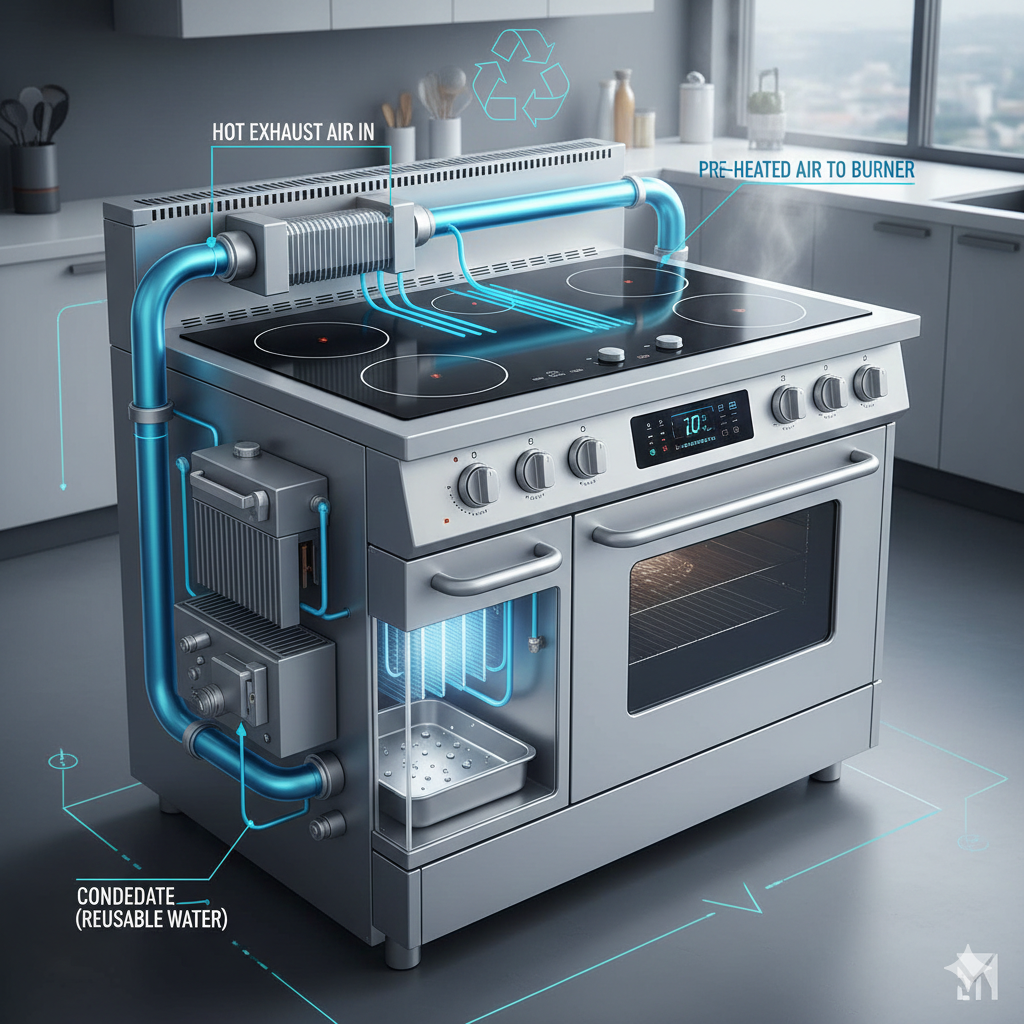
Gas ranges, ovens, electric cooktops that we use every day… you’d be shocked to know how much energy these cooking appliances waste. Today, I’ll introduce the concept of heat pump cooking appliances that reuse waste heat for cooking, and discuss how we can overcome practical limitations.
The Shocking Inefficiency of Cooking Appliances We Don’t Know About
When cooking with a gas burner, about 60% of the heat from the flame never even reaches the pot and escapes into the air. Electric coil ranges are better at about 74%, and induction at about 84%, but still not perfect.
The real problem is ovens.
| Cooking Method | Percentage of Energy Actually Used for Cooking |
|---|---|
| Gas Oven | 6% — 94% of input energy escapes through exhaust vents |
| Electric Oven | 12% — Better than gas, but most heat still wasted |
Gas ovens lose 94% of their input energy through exhaust vents, and electric ovens still waste 88% into thin air. This escaped heat raises kitchen temperature, forcing air conditioners to work harder, creating a double energy waste.
“What if we could recapture this wasted heat and use it for cooking?”
Heat Pumps — Magic Technology That ‘Moves’ Heat
Heat pumps work on the same principle as refrigerators and air conditioners. A special fluid called refrigerant absorbs surrounding heat as it evaporates, then a compressor pressurizes this refrigerant to high temperature and pressure, where it releases heat as it condenses, repeating this cycle.
Key Point: By using electricity to move heat from low to high temperature, you can obtain 2-4 times the thermal energy compared to the electrical input. This is called COP (Coefficient of Performance).
For example, if COP is 3, you use 1kWh of electricity to supply 3kWh of thermal energy.
But applying heat pumps to cooking appliances is a different story. While air conditioners only need to produce 40-50℃, cooking requires 150-250℃. Overcoming this temperature difference is the biggest challenge.
How Waste Heat Recovery Heat Pump Cooking Appliances Work
The core idea is simple and clear. Instead of just discarding the hot exhaust escaping from the oven, recover it with a heat exchanger and use it as the heat source for a heat pump.
Cooking chamber (heat generation) → Exhaust waste heat (heat exchanger recovery) → Evaporator (refrigerant absorbs heat) → Compressor (temperature elevation) → Condenser (heat supply to cooking chamber)
The heat pump’s evaporator absorbs waste heat from the exhaust passage, the compressor elevates this heat to higher temperature, then the condenser returns heat to the cooking space. It recycles “heat that would have been wasted” without additional fuel.
There’s a secondary benefit too. As exhaust air cools passing through the evaporator, water vapor condenses creating a dehumidification effect, and lower humidity inside the oven helps achieve crispy texture in baked goods and roasts.
Limitations and Compensation Strategies — A Realistic Perspective
No matter how good the idea, we must face practical barriers to make it truly viable technology. I’ve organized four key limitations and compensation strategies for each.
Limitation ① COP Drops Sharply in High-Temperature Range
When producing 200℃ using 80℃ waste heat as source, the theoretical maximum COP is about 3.9, but considering mechanical losses, practical COP is only 1.5-2.0. Above 250℃, it can become almost indistinguishable from electric heaters (COP 1.0).
Compensation Strategy: Combine cascade (multi-stage compression) systems with dual-mode operation. Separating low-temperature and high-temperature cycles reduces the temperature difference (ΔT) at each stage, suppressing COP degradation. Also, using a hybrid strategy where auxiliary electric heaters quickly heat during initial warmup, then letting the heat pump take over once temperature stabilizes can significantly improve real-world COP. Since most energy consumption occurs during the long maintenance phase anyway, even if the heat pump only handles this phase, overall energy savings are substantial.
Limitation ② Insufficient Refrigerants and Compressors for 200℃+
Air conditioner refrigerant R-410A already reaches its critical point around 70℃, and CO₂ has a critical temperature of 31℃. Water (R-718) is advantageous with a critical temperature of 374℃, but requires vacuum and large-scale equipment, causing costs to skyrocket.
Compensation Strategy: Next-generation refrigerants like HFO-1336mzz(Z) are promising candidates. With a critical temperature around 171℃, GWP (Global Warming Potential) below 2 making it environmentally friendly, and non-flammable for safety. Using this refrigerant enables 150-170℃output with single-stage compression, and adding 2-stage cascade can target 200℃+. For compressors, scroll compressor and turbo compressor technology are rapidly advancing, with 150-200℃ industrial high-temperature heat pump demonstrations already underway in Europe and Japan.
Limitation ③ Safety and Maintenance Burden of Silicone Oil Circulation
A system circulating 200℃+ hot oil with pumps poses fire and burn risks if leaks occur, and requires high-temperature resistant sealing and specialized piping, increasing costs.
Compensation Strategy: Three approaches are possible. First, sealed double-wall structure. Designing oil piping with double walls prevents oil from entering the cooking chamber even if the outer wall breaks. Second, minimized heat transfer media design. Using minimal oil and utilizing the oven wall itself as a heat exchange surface reduces circulation volume, simultaneously lowering leak risk and cost. Third, heat pipe application. Using heat pipes that transfer heat solely through internal refrigerant phase change (evaporation-condensation) without pumps as auxiliary means can greatly reduce mechanical failure points.
Limitation ④ Too Early for Home Use in Terms of Size and Cost
Combining heat pump unit, heat exchanger, oil circulation system, control devices, etc., results in considerable volume and price. For typical households using ovens 30 minutes to 1 hour daily, it’s difficult to recover the device cost through energy savings.
Compensation Strategy: Strategic market targeting is key. Initially focus on continuous operation environments running ovens 10+ hours daily—large bakeries, food factories, institutional kitchens. In such environments, abundant waste heat and long operating hours shorten investment recovery period to 2-3 years. As technology matures and component standardization lowers costs, a phased market entry strategy gradually expanding from restaurants → franchises → homes becomes realistic.
Efficiency Comparison — Potential by the Numbers
Let’s compare the expected performance of a system with compensated limitations against conventional methods.
| Cooking Method | Thermal Efficiency | Energy Needed to Supply 1kWh Heat | CO₂ Emissions |
|---|---|---|---|
| Gas Oven | 6-10% | 10-16 kWh (gas) | High |
| Electric Oven | ~12% | 1 kWh (electricity) | Moderate |
| Induction | ~84% | ~1.2 kWh (electricity) | Moderate |
| Waste Heat Recovery HP Oven (COP 2.0) | >100% | 0.5 kWh (electricity) | Low |
- 50%+ — Energy savings vs. conventional electric ovens
- 2-3 years — Expected investment recovery period for commercial environments
- 6.8%↑ — Annual growth rate forecast for high-temperature heat pump market
COP 2.0 means using half the electricity to produce the same heat. For a bakery running large ovens 10 hours daily, annual electricity bill savings alone are substantial. Add indirect savings from reduced cooling load, smaller ventilation systems, and eliminated gas infrastructure, and economic value grows further.
Phased Commercialization Roadmap
For this technology to become reality, we need a strategy of phased approach rather than attempting everything at once.
PHASE 1 — Industrial Demonstration (Current~Near-term). Pilot projects targeting food factories and large bakeries. Demonstrate in industrial sites where three conditions are met: 24-hour continuous operation, abundant waste heat, and high energy costs. Start with 150-180℃ range to establish technical reliability. With 40% of industrial process heat demand below 300℃, the market itself is huge.
PHASE 2 — Commercial Expansion (Mid-term). Large restaurants, franchises, institutional kitchens. Modularize and standardize technology proven in industrial applications. For example, standardizing 10kW heating modules enables manufacturers to design various products based on them. Just as outdoor AC units are standardized, standardization is key for heat pump cooking modules.
PHASE 3 — Home Market Entry (Long-term). When compactification and cost reduction are achieved. Once component technology matures and mass production effects sufficiently lower prices, enter from the premium home oven market. As carbon neutrality policies raise gas prices and consumer awareness of energy efficiency grows, home demand will gradually emerge.
Conclusion — The Key is ‘Where and When’ to Apply
Waste heat recovery high-temperature heat pump cooking appliances are thermodynamically valid technology with high energy-saving potential. However, they’re not universal for all environments.
Conditions where this technology shines:
- Long, continuous cooking environments (bakeries, food factories, institutional kitchens)
- High-temperature cooking generating abundant waste heat (ovens)
- Regions with high energy costs or strong carbon regulations
- Large commercial kitchens with high cooling loads
High-temperature heat pump technology isn’t limited to cooking appliances. It’s evaluated as key technology for decarbonization in process drying, low-temperature steam supply, industrial heating, etc., with market growth forecasted at 6.8%+ annually.
The key to overcoming conventional cooking appliance limitations already exists. Cascade systems, next-generation refrigerants, hybrid operation, double-wall safety design… these complementary technologies are gradually taking root. Ultimately, “applying to the right target at the right time” will determine this technology’s success.