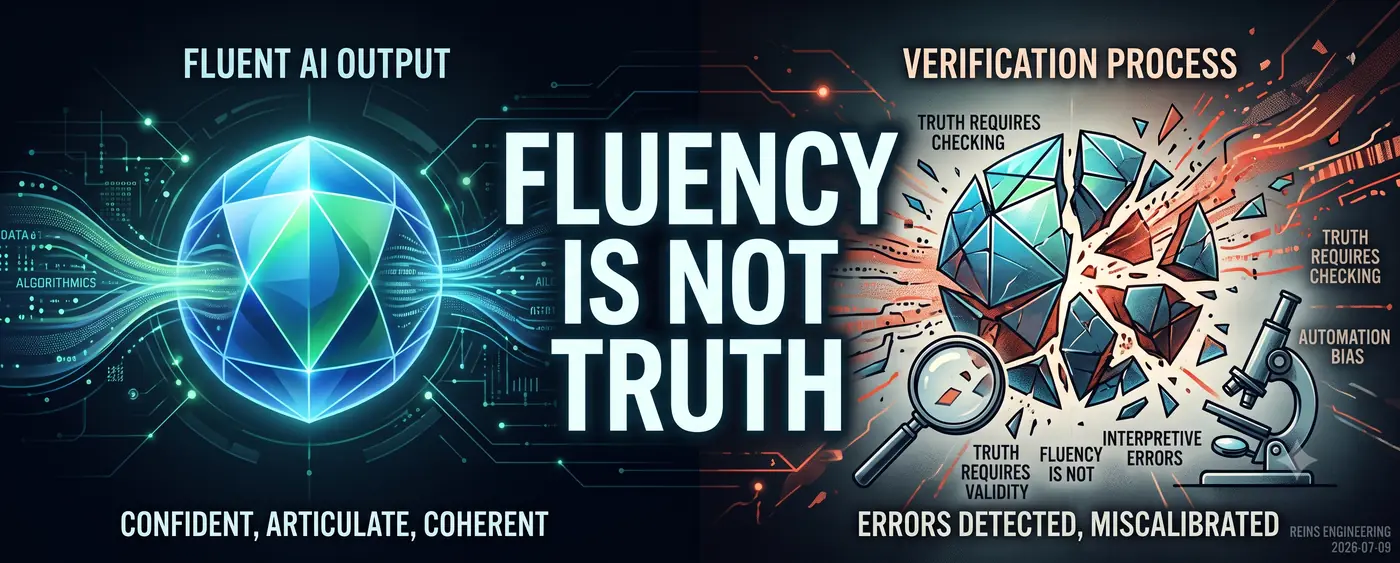
 Image: AI generated
I asked an AI to research something, and it came back polished, structured, certain — and wrong in a way I only caught by accident. My first reaction was: am I using this wrong? The literature says no. Not noticing is the default outcome for careful people, and the fix is not vigilance. It’s converting the discomfort into something a machine can check.
The Fluency Heuristic LLMs Broke
Humans run on a cheap shortcut: if something is easy to process, it’s probably true. Psychologists call it the fluency heuristic, and for most of history it was a reasonable bet — a speaker who sounds articulate, confident, and coherent usually is more competent, because producing that kind of speech under human constraints is hard to fake for long. LLMs are the first mass-produced speakers who break that correlation. Fluency now costs the model nothing. Confidence is a token distribution, not a signal of verified understanding.
The gap shows up directly in how people rate AI output: given the same answer, people judge it as more confident when they’re told it came from an AI than when they’re told it came from a human (phys.org, 2026-05). The model didn’t get more sure of itself. The reader’s prior did.
Experts Are Not Exempt
If this were a problem of inexperience, training would fix it. It doesn’t.
Physicians who had already been trained on AI-assisted diagnosis still failed to filter out plausible-sounding, incorrect LLM recommendations — automation bias survived the training that was supposed to inoculate against it (medRxiv, 2025-08). That’s the mechanism, and it’s worse than it sounds, because the errors that get through aren’t the easy kind. Interpretive-level errors are harder to catch than factual ones — a wrong name or a wrong date stands out; a wrong frame doesn’t, because it sounds plausible and fits the narrative the reader already expected (Not Wrong, But Untrue, arXiv:2509.25498). Domain knowledge catches facts. It doesn’t reliably catch framing.
Underneath both findings is a calibration gap: LLMs report confidence at a level that systematically exceeds their actual accuracy. Measured across eleven models and six question sets, average stated confidence was 88% against an actual accuracy of 79% (Confidence Calibration in Large Language Models, arXiv:2605.23909). The model isn’t lying about being sure. It’s miscalibrated, and the miscalibration reads as authority.
Feeling Faster While Being Slower
The clearest demonstration that this isn’t a knowledge problem comes from METR’s 2025 study of experienced open-source developers — 16 developers, 246 real tasks, repositories averaging over a million lines of code. These aren’t people who trust AI naively. They work in production code every day.
- They expected AI to make them 24% faster.
- They were measured to be 19% slower.
- After finishing the tasks — with the actual time cost already behind them — they still believed they had been 20% faster.
The illusion persisted after the task was already finished and timed. That’s the part worth sitting with: felt experience is not evidence, and it does not self-correct. A working, shipping, “it feels productive” state can persist stably even when it’s measurably not productive, and no amount of having gone through it fixes that on its own.
To be precise about what this study can carry: sixteen developers is a small sample, and METR itself is explicit that the result is setting-specific — seasoned maintainers, mature million-line codebases they knew deeply — and shouldn’t be stretched into “AI slows everyone down.” So don’t carry the 19% anywhere as a point estimate. What this argument leans on is not the magnitude but the sign of the gap: the measured effect was negative, the perceived effect was positive both before the work and after it, and the average post-hoc estimate landed near the prior expectation, nowhere near the measurement. If self-perception were merely noisy, the after-the-fact estimates would scatter around the measured truth. They didn’t. They stayed where the expectation was.
Why Verification Economics Collapsed
Before LLMs, judging output quality by looking at the output was a reasonable proxy for judging the producer’s competence — the two were correlated, because sloppy work came from sloppy production. LLMs severed that link. Output quality and producer competence are no longer coupled, which means artifact-only evaluation stopped working as a diagnostic (Fluent, Confident, Wrong, ScienceDirect 2026). Verification got more expensive than production.
Worse, the cost of an error is not proportional to the error rate. When the wrong parts read exactly like the right parts — same register, same confidence, same polish — you can’t localize the damage, so a few percent of contamination doesn’t cost you a few percent. It poisons the whole bucket: every claim in the output now carries the suspicion of the worst one. That’s why “the model is right 95% of the time” is not the reassuring number it sounds like. Trust collapses discontinuously long before accuracy does.
Almost nobody’s verification habits updated to match — which is exactly the gap this site’s Ratchet Pattern argument is built on: generation can stay probabilistic, but the check on it cannot.
Not Misuse — The Population Default
So: am I using it wrong? The literature says the opposite. The textbook definition of misuse is treating fluency as a trust signal and turning verification off — and that’s not an edge case, it’s what most people, including trained ones, default to. The physicians in the automation-bias study didn’t hold onto their disagreement signal. Neither did the developers in the METR study. If staying suspicious in front of a fluent, unfalsifiable-looking answer feels like paranoia, it’s worth noticing that it already puts you ahead of most of the measured population — including the ones whose job was specifically to catch this.
This isn’t a new observation for this site — it’s the same territory sycophancy as a business feature and why agents work and why they break both land on: the failure mode is structural, not a personal lapse in attention, and no amount of “just be more careful” scales against it.
The One Fix
There is exactly one adjustment that matters here: don’t stop at the feeling of unease. Convert it into an observable acceptance criterion, and set that criterion before the work starts, not after. Feeling is not self-correcting — METR proved that directly — but measurement is.
“Convert” is a procedure, not a mood. For any load-bearing claim — one about to shape a decision — answer two questions before you let it:
- What has to be true for this to hold? Fluent output rarely states its premises; it launders them into the frame, which is exactly why domain knowledge slides off it. This question drags the hidden premise up to the level of a claim, where it can finally be attacked.
- What would I observe if this were wrong? This forces the claim to put a stake in the world. A conclusion that implies no observable difference from its own negation isn’t knowledge — it’s coherence, and coherence is what a model optimizes when nothing is at stake.
For AI-generated code, both questions compress into a single blank, filled in before the code exists: “If this is useful, then immediately after it ships, a user can ___.” The blank must name an action in the user’s world, not the code’s — a clean build and a passing runtime are coherence checks, not usefulness checks. And if you can’t fill the blank, that’s the most valuable output of the whole procedure: it means you don’t yet know what you asked for, and the fluent answer was about to hide that from you.
Everything else in the mitigation literature — separating confident language from verified fact, breaking output into independently checkable units, building friction in before the fluent answer lands — is this same conversion applied at different layers.
“Isn’t This Just Skepticism, Rebranded?”
The obvious objection: “check before trusting” is what skepticism has always meant, so what’s actually new here? The answer is when the judgment happens, and the timing is the entire mechanism.
Skepticism is a posture you apply while looking at the output — and every study above is a measurement of exactly that posture failing. The physicians weren’t credulous; they had been trained on AI-assisted diagnosis — the intervention that is supposed to install exactly this posture — and they were looking straight at the recommendations. The recommendations disarmed them anyway, because a fluent artifact modulates the judgment applied to it — that’s what the fluency heuristic is. A criterion set before the output exists has no fluent artifact to be disarmed by. There is nothing for the confidence to work on, because the test was fixed at a point in time the output cannot reach.
Science institutionalized the same move for the same reason. Preregistration doesn’t exist because reviewers lack skepticism; it exists because a researcher looking at already-collected data can rationalize any result fluently, so the field moved the hypothesis to before the data. If this distinction were empty — if skepticism-after worked as well as criteria-before — then trained evaluators would filter bad recommendations at high rates. That is precisely the experiment the automation-bias study ran, and it came back negative.
“Verification Costs More Than Production — Who Can Afford It?”
The sharper objection: if checking output costs more than generating it, then “verify before trusting” is advice to be slower than everyone else, and most real decisions can’t pay for it. This misreads the prescription twice.
First, the criterion is not the verification. Writing down what you’d observe if the claim were wrong costs a sentence, and you only pay the checking cost on claims that are load-bearing. A pre-specified observable is also far cheaper to check than a fluent artifact is to audit open-endedly — most of the cost of post-hoc verification isn’t the checking, it’s not knowing where to start, and the criterion is what collapses that search space.
Second, skipping verification doesn’t remove the cost — it moves it downstream and takes it off the books. The METR developers didn’t avoid paying; the cost showed up in measured time while their felt accounting recorded a profit. That is the comparison the objection gets wrong. It is not “verification versus free.” It is verification now, priced and visible, against error absorption later, unpriced and booked as a gain.
Write the Reviewer as Code
The two-question procedure above still has a weak point: it depends on someone remembering to run it. That’s the same failure restated one level up. A discipline that lives only in a person’s head degrades exactly like unease does — sharp on the first careful read, gone by the tenth fluent one. The durable form of “convert it into an observable acceptance criterion” is not a habit. It’s a build step: hand the criterion to a machine and make the pipeline refuse to pass without it.
This isn’t hypothetical — it’s what gated the article you’re reading. Reins is an open-source framework built for exactly this: each acceptance criterion becomes a quest, a rule that evaluates a Fact{Where, Expected, Actual} and reports pass or fail without ever asking whether the surrounding prose sounds convincing. Before a sentence of this piece existed, a human wrote down the specific claims it was allowed to make; a machine screened the draft against that list; and the reviewer who checked claim coverage worked from a context separate from the one that wrote the draft, because self-review isn’t a review — abloq, the quest system this site runs on, encodes that as a rule, not a request.
That’s the actual content of “don’t just feel it.” Not more vigilance — a place in the pipeline where vigilance is no longer the dependency. The two questions from the previous section — what has to be true, what would falsify it — stop being something you have to remember to ask once they’re a gate rule instead of a mental note. A quest doesn’t get tired on the tenth read.
Related Posts
- AI Sycophancy Bias Is a Business Feature — why LLM-as-Judge can’t self-correct for the same structural reasons
- Why Coding Agents Work and Why They Break — the case for moving verification outside the model entirely
- Precedent Is Not Truth — a concrete incident of fluent, confident output turning out to be wrong
- reins — the framework behind turning an acceptance criterion into a checkable quest
- abloq — this site’s own agent-operated, machine-gated writing pipeline
Sources
- People overestimate how confident AI systems are in their responses (phys.org, 2026-05)
- Automation Bias in LLM-Assisted Diagnostic Reasoning Among AI-Trained Physicians (medRxiv, 2025-08)
- “Not Wrong, But Untrue: LLM Overconfidence in Document-Based Queries” (arXiv:2509.25498)
- “Confidence Calibration in Large Language Models” (arXiv:2605.23909) — the 88% stated confidence vs. 79% accuracy measurement, 11 models, 6 question sets
- Measuring the Impact of Early-2025 AI on Experienced Open-Source Developer Productivity (METR, 2025-07-10)
- “Fluent, Confident, Wrong: Why LLMs’ Most Underexploited Pedagogical Use Is Producing Errors” (ScienceDirect, 2026)
- Hero image: AI-generated (Google Gemini)
Changelog
- 2026-07-09: Initial release