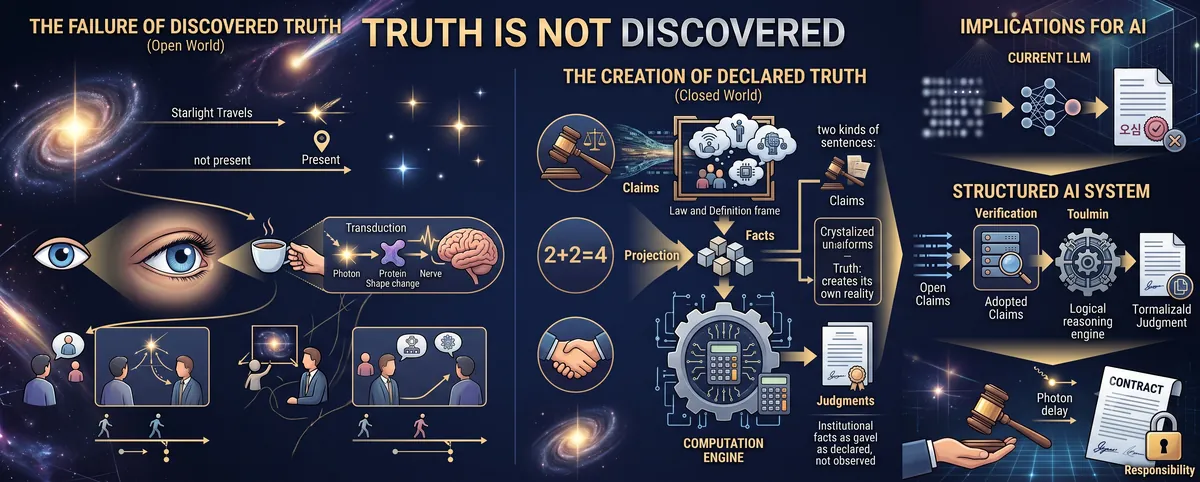
 Image: AI-generated
In the open world of our universe there exists no truth to discover. Yet we can declare truth, and a declared truth is true only within the world it opens. This is not cynicism. It is physics, and then it is law.
Light Always Arrives Late
No observation travels faster than light.
You look at a star in the night sky. That light departed thousands of years ago. What you see now is not the star, but a claim that the star once existed. It may already be gone (Speed of light, Wikipedia).
Do not treat this as a story about distant stars alone. Look at the cup in your hand. It takes time for the light bouncing off the cup to reach your eye. Very brief, but not zero. The cup you see is always the cup of a moment ago. You never reach the cup of this present instant. An event vanishes into the past the instant it occurs — faster than light. What remains to us is not the event, but only the messenger the event sent. And the messenger always arrives after the event is already dead.
There Is No Zero-Hop Observation
The moment light strikes the retina is not pure transmission but conversion. A photon changes the shape of a protein, that change triggers a chain reaction, the signal climbs the nerves, and the brain calls it “red” (Visual phototransduction, Wikipedia). Every step of this chain is a reinterpretation. Our optic nerve is not a window open onto the world, but an inference model about the world (Unconscious inference, Wikipedia).
Therefore even the observation closest to the event — a retina where a photon has just landed — is already an inference at least one hop away. A zero-hop observation has never existed. We have not once touched the world directly. When we say a camera “sees” a cup, we know that is the sensor’s inference. The human eye is no different. It is not a privileged channel of direct contact, but merely one sensor.
In the Open World There Is No Truth — Only Claims
What, then, remains to us in the open world? Evidence and claims. And if you look just a little closer, evidence is only another name for a claim.
“The camera saw this cup” is evidence. But it is nothing more and nothing less than “a sensor claimed, at this time, with this confidence, that such a cup existed.” Dig into the evidence and inside it is another claim; dig into the grounds of that claim and there is yet another claim. There is no bottom. Nowhere does it stop at “this is simply true.”
That is why the semantic language GEUL that I design has no “Fact” type. It was not deliberately removed; it simply could not be placed in the slot meant to hold the open world. The moment you place it, it becomes a lie. Even the most basic-seeming claim — “these two are the same object” — divides into confirmed and candidate, and what separates the two is not a separate “fact stamp” but merely whether a confidence value is attached. A certain fact and an uncertain guess are not different in kind. The difference is only whether the same structure carries the label called confidence. This is not a philosophical declaration but a bit layout. It is built so that if the philosophy collapses, the schema collapses.
And Yet Truth Exists — In the Closed World
In the open world there is no truth to discover. But that does not mean there is no truth at all.
Look at fiction. “Hong Gil-dong was a bastard son” is true within that world, because the author wrote it so (Fiction — Truth in Fiction, SEP). There is no external world to verify against, and the author is at once the sole source and the final instance of that world. Here no observation is needed. When the author declares, that thing exists. The event does not precede the declaration; the declaration is the event.
Mathematics has the same structure. “Two plus two is four” is true within the world that the axioms have closed. The axioms are the author, and the theorems are the characters of that world. It was not obtained by observing the physical world but deduced from definitions, so the speed of light does not apply here (Formalism in the Philosophy of Mathematics, SEP). Truth fails, then, not because truth itself is wrong, but because we write truth in a world that has not been closed. Physical reality has no authority to close a world. But fiction and axiomatic systems have that authority.
Truth Is Not Discovered but Declared
There are two kinds of sentences. One describes the world. “The cup is here.” It is an attempt to point to something that already exists. So it is bound by the speed of light and remains forever a claim. The other creates the world. “I hereby declare the two of you husband and wife.” This sentence does not describe a marriage. It brings a marriage into being. Before the utterance there is no object to point to. The utterance gives birth to the object (Speech Acts, SEP).
The first sentence can be asked whether it is true or false. The second cannot be asked whether it is true or false — because the utterance is the event. This is the real reason a closed world can possess truth. Not because the world is closed, but because these worlds are worlds built by declaration. So truth is not discovered. Truth is manufactured. And nearly all of human civilization — law, money, contracts, promises, the state, fiction — stands upon this manufactured truth.
A Trial Is Projection, a Verdict Is Computation
Law is the most refined realization of this principle. The judge does not discover truth. The judge is a mathematician. But he does two things in succession.
A trial is the process of projecting the real world onto the legal world, and a verdict is the result of computing upon the facts projected into the legal world. The first motion is projection. It lowers the infinite, open reality into a finite, closed coordinate system called the legal world. The admission of evidence is precisely this projection, and like all projections it has loss — most of reality cannot enter the courtroom, and only what enters becomes fact. The moment a claim of the open world is admitted into the courtroom, it ceases to be a claim about reality and begins to function as a fact within the legal world. But this is not a promotion to absolute truth of the open world; it is a claim that functions as a fact only within this closed world.
The second motion is computation. Once projection is complete and the world is closed, the verdict is computed deterministically, taking the statutes as axioms. The first is the author’s motion (declaring a world); the second is the mathematician’s motion (deducing a theorem). What makes the judge a singular being is that one person does both in succession.
This view is not speculation drawn from thin air. The law of evidence has long distinguished formal legal truth from substantive truth. The ideal a trial aims at is substantive truth, but the rules of evidence, the burden of proof, and the limits of time block its attainment, so “what actually happened” and “what was legally established” diverge (Summers, Formal Legal Truth and Substantive Truth in Judicial Fact-Finding, Cornell Law). The philosopher John Searle revealed the grammar of this conversion — an institutional fact always has the form “X counts as Y in context C,” and what triggers that counting is not observation but declaration (Searle, Constitutive Rules, Argumenta; Social Ontology, SEP). The sociologist Niklas Luhmann explained the entire legal system with this principle — law is cognitively open and normatively closed, and processes everything only through the binary code of legal/illegal (Critical Legal Thinking, Niklas Luhmann: What is Autopoiesis?). The two motions I split into projection and computation were, for Luhmann, cognitive openness and normative closure.
A Miscarriage of Justice Separates Declaration from Discovery
Within the closed world, the verdict is truth. But whether that world matches reality remains a claim.
When the judge says “guilty,” within the legal world he is guilty. Mathematically. Regardless of whether he might not be the true culprit. This is precisely why the concept of a miscarriage of justice can hold — because legal truth (the verdict of the closed world) and physical claim (what actually happened) are different layers, the two can diverge (Miscarriage of justice, Wikipedia). If the verdict were physical truth, a miscarriage of justice would be logically impossible. But we can speak of miscarriages of justice. The very fact that such speech holds proves that declared truth is not discovered truth.
Right Now the LLM Is a Judge Without a Case Record
The LLM is made of closed mathematics. It multiplies matrices, computes probabilities, and picks the next token by a fixed algorithm. Its internal computation is mathematically closed. But the input the LLM handles comes from the open world. Questions have incomplete context, learned knowledge mixes sources and timestamps, and search results conflict with the user’s claims. Without leaving a record of which of these it adopted as fact (Measuring Attribution in NLG, arXiv:2112.12870), the model briefly closes the open world within its parameters and computes an answer.
The current LLM is like a judge with no case record and no procedure for admitting evidence. Which claims it adopted and which it rejected, which moment’s world it is handling, what would have to change to reopen the case — none of this remains. And yet the answer comes out as categorically as a verdict (Survey of Hallucination in Natural Language Generation, arXiv:2202.03629). Even if the model’s mathematics is not wrong, a miscarriage of justice occurs. Because the projection that closes the open world is implicit, not reproduced, and no one is responsible for its boundary. A bigger model and more parameters may ease this problem but cannot eliminate it (Hallucination is Inevitable, arXiv:2401.11817; Why Language Models Hallucinate, arXiv:2509.04664). It is impossible to fully close the entire open world within parameters.
First Declare a Computable World
What the LLM needs is not only more perfect memory, but an explicit closure procedure like the rule of law (The Rule of Law, SEP).
First, receive everything that comes in from the open world as a claim — who claimed what, when, on what grounds, within what scope, and with how much confidence. Then close the world for a specific question — decide which claims to adopt, reject, and hold, and project them into a computable found fact. This found fact is not promoted to absolute truth. It is a claim that functions as a fact only within a specific closed world. Upon it the verdict is computed, and when new evidence arrives, the case must be able to be reopened.
This is what GEUL will do. GEUL preserves the claims of the open world without losing them. Upon them, the Toulmin argument engine takes the closed graph of admitted grounds and rebuttals as input and computes the verdict deterministically (Argumentation framework, Wikipedia). The engine does not adjudicate truth. Just as the judge is a mathematician, the engine too is a mathematician. Not an adjudicator but an executor. The goal is not to make the LLM infallible, but to structure the miscarriage of justice, to separate the error of projection from the error of computation, to reveal who admitted what, and to make appeal possible in the face of new evidence.
Declaration Must Carry Responsibility
But when declaration becomes cheap, the world is polluted. If anyone can declare anything, truth undergoes inflation — as the internet does now, as the sentences AI pours out do. So what is needed is not truth but responsibility.
Declaration requires authority, and authority must carry responsibility (Moral Responsibility, SEP). Just as no world is closed when someone who is not a judge shouts “guilty,” a declaration is not an object of true/false but of validity. And responsibility is ultimately borne in money — because it is the only means that is measurable, transferable, and divisible in proportion to fault (Legal liability, Wikipedia). For that, the declaration must first be identified. Who declared it, by what authority, and from what. This is why GEUL forcibly encloses source, timestamp, and confidence with every claim. To assign responsibility, you must first cut the declaration into monetizable units.
Truth is not discovered. But truth can be declared. And that is enough. Light always arrives late, despite being the fastest thing in the universe.
Related Posts
- Fluency Is Not Truth — an argument from the same epistemological root: do not accept fluent AI output as a trust signal, but convert it into an observable criterion
- reins — Leave Only the Domain in the Quest CLI, and the Ratchet Becomes a Framework — the substance of the Toulmin argument engine that computes verdicts deterministically upon closed input
- abloq — An Agent-Operated Blog, Where Verification Is Locked by Machine — an instance of a writing pipeline that forces an explicit closure procedure on declaration
Sources
Physics — Observation and Light
- Speed of light (Wikipedia) — the speed of light is a finite upper bound on information and matter, identical for all observers. The starlight seen from Earth belongs to the distant past
- Lookback time / Cosmic time (Wikipedia) — because of light’s travel time, the more distant the object, the further in the past it is observed
- Meter (NIST) — the 1983 redefinition fixed the speed of light at 299,792,458 m per second
- Visual phototransduction (Wikipedia) — the retina does not passively transmit light but converts it through a biochemical chain
- Unconscious inference (Wikipedia) — Helmholtz’s unconscious inference: perception is not direct contact but a statistical inference estimating the cause of sensory input
Truth · Declaration · The Closed World
- Speech Acts (Stanford Encyclopedia of Philosophy) — Austin’s performative/constative distinction: some utterances make a fact by saying it so
- Performative utterance (Wikipedia) — a performative does not describe reality but changes social reality. An object of success/failure, not of true/false
- Fiction — Truth in Fiction (Stanford Encyclopedia of Philosophy) — the author-centered theory that truth in fiction is stipulated by the author
- Formalism in the Philosophy of Mathematics (Stanford Encyclopedia of Philosophy) — mathematical truth is provability within the rules of a system, not correspondence with physical reality
- Axiomatic system (Wikipedia) — the structure of deducing theorems from axioms
Law — Projection · Computation · Responsibility
- Formal Legal Truth and Substantive Truth in Judicial Fact-Finding (Robert S. Summers, Cornell Law) — the divergence between the substantive truth a trial aims at and the formal legal truth created by the law of evidence, the burden of proof, and time constraints
- Constitutive Rules (John R. Searle, Argumenta) — the form of institutional facts, “X counts as Y in context C,” and the power of declaration to create reality
- Social Ontology (Stanford Encyclopedia of Philosophy) — institutional facts and status functions are imposed by collective recognition and declarative speech acts
- How the Facts Enter Into the Law (Springer) — the view that, since law is a normative order, it can process reality only by converting “facts of reality” into “states of legal fact”
- Niklas Luhmann (Wikipedia) — social systems are operationally closed while informationally open to their environment (normative closure, cognitive openness)
- Miscarriage of justice (Wikipedia) — a wrongful conviction shows the divergence of the legal verdict from factual innocence
- The Rule of Law (Stanford Encyclopedia of Philosophy) — applying pre-declared general rules impersonally rather than by individual discretion creates predictability
- Moral Responsibility (Stanford Encyclopedia of Philosophy) — the answerability and sanction-liability strands of responsibility
- Legal liability (Wikipedia) — legal liability is an enforceable, payable obligation spanning contract, tort, tax, and fines
LLM — Epistemology and Hallucination
Measuring Attribution in Natural Language Generation Models (arXiv:2112.12870) — the AIS framework for evaluating whether output is attributable to and verifiable against an identified source
Survey of Hallucination in Natural Language Generation (arXiv:2202.03629) — defines hallucination as unfaithful generation and surveys mitigation methods
Hallucination is Inevitable: An Innate Limitation of Large Language Models (arXiv:2401.11817) — from learning theory, LLMs necessarily hallucinate and it is not eliminated by scale
Why Language Models Hallucinate (arXiv:2509.04664, OpenAI) — hallucination arises from the statistical pressure of pre-training and persists even in the latest systems
Argumentation framework (Wikipedia) — Dung’s argumentation framework: from arguments and attack relations, it computes which argument is justified with a deterministic semantics
Hero image: AI-generated
Changelog
- 2026-07-23: First edition