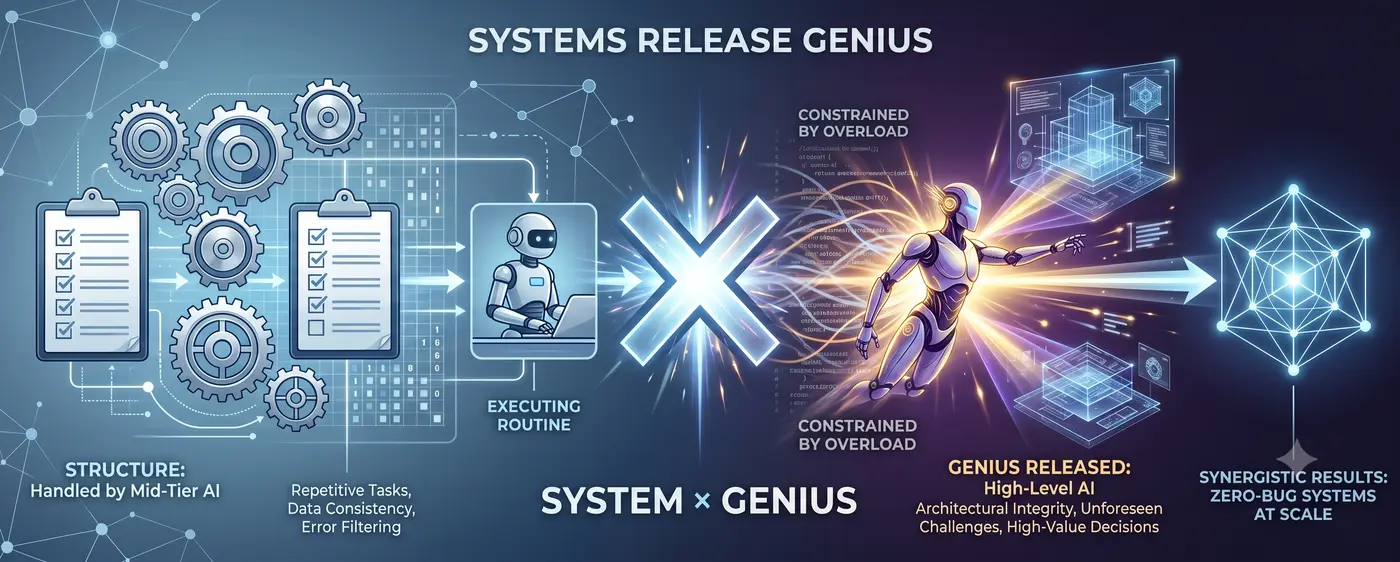
 Image: AI generated
A McDonald’s crew member is not a Michelin-starred chef. Yet a Big Mac in Seoul tastes the same as a Big Mac in New York. Systems create consistency.
At this point, most people conclude: “Talent is unnecessary. Systems are enough.” I once thought so too. I was wrong.
McDonald’s system does not replace chefs. It liberates them. Because store employees no longer need to memorize grill temperatures, the chefs at headquarters can focus entirely on developing new menu items. Because the system handles repetition, human creativity flows only to where creativity is actually needed. Systems don’t replace genius. They create the conditions for genius to be genius.
The same principle applies to AI agents. Genius without structure drifts. Structure without genius is mediocre. The interesting thing happens when you combine them.
A History of Liberation Through Structure
In 1935, a Boeing B-17 crashed during a test flight. Not because the pilot was incompetent. The aircraft had grown too complex for any single person’s memory to handle every procedure. The solution was not to find a better pilot but to create a checklist. After that, the B-17 flew 1.8 million miles without a single accident.
The conventional interpretation is that “the checklist replaced pilot skill.” But what actually happened was different. Because the checklist took over the cognitive load of procedural memory, the pilot could focus entirely on situational judgment: making decisions in turbulence, reprioritizing in emergencies. Once the checklist handled mechanical repetition, the pilot’s judgment finally shone.
The Toyota Production System (TPS) follows the same structure. Pull the andon cord and the line stops. Not a single car ships until the problem is solved. Standard Operating Procedures (SOPs) create repeatable quality. But the real power of TPS is not the SOPs themselves. Because SOPs absorb variation in daily operations, engineers can spend their time on kaizen, fundamental improvement. Structure handles repetition, so people focus on improvement.
Atul Gawande’s research brought this into the operating room. Hospitals that adopted the WHO Surgical Safety Checklist saw a 36% reduction in complications and a 47% reduction in mortality. The checklist is a single sheet of paper with 19 items. It did not improve the surgeon’s skill. It offloaded cognitive burdens like “don’t leave gauze behind” to the system, freeing surgeons to concentrate on truly difficult judgments: immediate response to unexpected bleeding, real-time redesign of the surgical approach.
The pattern is the same. When structure takes over repetition, human capability concentrates on judgment and creativity. A system’s value isn’t replacing talent. It’s making sure talent isn’t wasted on things that don’t need it.
The Same Principle Applies to AI
The dominant narrative in AI right now is “bigger models, more parameters, higher benchmarks.” The belief that smarter models solve problems. Partly true. But only half true.
Give the most powerful model no structure and say “build me an app.” What happens? The first 100 lines are clean. Past 500 lines, it forgets interfaces it created. At 1,000 lines, rules established earlier get violated later. Once endpoints exceed 30, DB schemas and API specs begin to quietly diverge.
This is not because the model is stupid. Maintaining consistency across every decision within a context window is structurally near-impossible. Humans can’t do it either. For the same reason the B-17 pilot couldn’t. When complexity exceeds a single agent’s cognitive capacity, no matter how talented that agent is, things slip through.
I call this drift. The phenomenon where an agent, running in iterative loops, gradually deviates from the original spec. Without structure, drift is inevitable. Upgrading the model only delays when drift appears. It never eliminates it.
Here is the key point. Without structure, even Opus wastes its reasoning power remembering field names. With structure, Opus can focus its reasoning on “how should I decompose this domain?” A smart model only does smart work when structure handles the dumb work.
43 Minutes, 32 Endpoints, Zero Bugs
There is evidence. The ZenFlow benchmark.
Claude Sonnet 4.6, not the top-tier model (Opus) but a mid-range one, built an app end-to-end inside yongol’s SSOT structure.
Results:
- 32 endpoints, 9 DB tables, 9 query files, 37 Hurl tests, all passing
- Approximately 43 minutes
- Code generation bugs: 0
The model did not avoid all mistakes. There were 4 errors (BUG-077~080). What matters is that all 4 were classified as “SSOT authoring mistakes.” Not code generator bugs: the agent wrote the spec incorrectly. And the system caught it. validate reported failures, the agent corrected the specs, re-ran, and passed.
About 16 of the 43 minutes were spent on this validate loop. That was the system teaching the agent.
Sonnet is “less smart” than Opus, with lower benchmark scores across the board. Yet within structure, it produced production-quality code. Not because genius is unnecessary, but because structure handled execution so genius didn’t have to.
Because structure enables Sonnet to handle execution at sufficient quality, the genius model can be deployed only to design and judgment, the truly hard domains. The same mechanism as McDonald’s crew members consistently producing hamburgers so that headquarters chefs can invent new menu items.
Three Gears
Decompose this structure and three components emerge. I call this the Ratchet Pattern. Each gear takes over one thing that genius no longer needs to worry about.
1. SSOT: What to Build
Single Source of Truth. In yongol, 9 declarative spec files serve this role. OpenAPI defines endpoints, DDL defines tables, Rego defines permissions. The key is that all 9 are chained through a single identifier: operationId. For a given endpoint, the API spec, DB query, test, and permission rule are all bound to the same key.
What SSOT takes over: memory. Field names, relationships, constraints. Genius doesn’t need to remember them. The spec remembers.
2. Codegen: How to Build It
Code is generated from the SSOT. The agent does not write code freely; it writes code derived from the spec. Drift is structurally suppressed. What is not in the spec cannot be created; what is in the spec cannot be omitted.
What Codegen takes over: repetition. Writing boilerplate for 32 endpoints one by one is not work for genius. Structure does that.
3. Gate: Was It Built Correctly?
Deterministic verification. validate checks consistency across all 9 specs. If an operationId exists in OpenAPI but not in Hurl tests, fail. If a column exists in DDL but is not referenced in sqlc queries, warning. Nothing proceeds to the next stage without passing.
What Gate takes over: inspection. Checking consistency across 32 endpoints by eye is the same as a B-17 pilot trying to remember procedures from memory. Measurements determine acceptance.
When these three gears interlock, they become a ratchet. What has passed does not regress. If the agent makes a mistake, the gate catches it. The agent fixes it. Re-verification runs. The only way out of this loop is “pass.” And while this entire loop runs, genius can be designing the next problem.
When Genius Shines
So where does genius come in? Everywhere outside the structure. That’s where the real value is.
The person who wrote McDonald’s manual was not a crew member. The person who designed recipes, decomposed processes, and decided where to place inspections was an expert. The same goes for Toyota’s andon cord. It was Taiichi Ohno’s insight that defined the conditions for stopping the line. Systems handle execution, not design. Design is the domain of genius. Because structure lifted the burden of execution, genius can immerse itself in design alone.
The same is true in AI. Writing yongol’s SSOT (judging which endpoints are needed, designing table relationships, deciding the permission model) requires deep reasoning. The exploration before structure is established, architectural judgments without precedent, the question “how should I decompose this problem?” None of that fits inside a structure. This is where a strong model earns its cost.
So in practice, I split models between roles. Design and judgment go to Opus; execution within structure goes to Sonnet. This dual-model pattern is the most direct realization of “systems make genius shine.” Opus doesn’t burn tokens on field names or boilerplate. Structure handles that. Opus focuses solely on architecture decisions, domain decomposition, edge-case judgment, work that only Opus can do.
An architect who doesn’t carry bricks isn’t disrespecting brickwork. The crew handles that so the architect can focus on blueprints. Putting your best talent on every task isn’t thoroughness; it’s waste.
Not Saving on Expensive Models: Using Them Properly
Look at the pricing.
Claude Sonnet’s output token price is $15/M-token. Opus is $75/M-token. A 5x difference. Without structure, assigning the entire pipeline to Opus means most of Opus’s capacity goes to boilerplate generation and field-name consistency. Like paying a $75/hour architect to carry bricks.
With structure, the story changes. Execution (code generation, consistency maintenance, passing tests) is handled by Sonnet within the structure. As ZenFlow proved, at quality that passes gates 100%. Opus is deployed only for design and judgment. The same budget concentrates Opus’s attention at 5x density.
Call it budget allocation, not cost reduction. Genius where genius is needed; structure where structure suffices. Lower total cost is a side effect; the real effect is higher quality output. What genius produces when doing genius-level work is on a different plane from what genius produces when buried in busywork.
Open Questions
To be fair, some things remain unproven.
ZenFlow is one benchmark. 32 endpoints is mid-scale in production. Whether the same pattern holds at 200 endpoints is still being validated. There are measurements showing yongol’s context compression at roughly 10x, but whether this scales linearly to hundreds of endpoints requires additional data.
Another point. Writing the SSOT itself demands expertise. Returning to the McDonald’s analogy: someone who can write the manual must exist first. For structure to make genius shine, a genius who can design the structure is needed first. Not circular. Sequential. One act of design sustains infinite acts of execution.
But the core pattern holds.
Multiplication
“How smart is your AI?” is only half the question.
The other half is this: “Where does your structure focus that intelligence?”
When the B-17 had no checklist, even the best pilots crashed. After the checklist, average pilots flew 1.8 million miles without incident, and exceptional pilots gained the space to tackle challenges that had never existed before. If Toyota had said “hire better engineers” instead of implementing the andon cord, lean manufacturing would never have existed. Because the andon cord existed, engineers could focus on kaizen.
AI is the same. New models ship every year. Last year’s strongest model is this year’s mid-tier. But investment in structure endures across model changes. SSOT specs work with Sonnet, work with Opus, and will work with next year’s model. And as models grow stronger, what structure liberates grows with them. The value of structure increases alongside the model.
Genius alone drifts. Structure alone is mediocre. When genius and structure multiply, only then do they reach places neither could reach alone.
Systems don’t beat genius. They make genius shine brighter. Not a new discovery. Proven since 1935. We just hadn’t applied it to AI yet.
Related Posts
- Reins Engineering — AI with Reins
- Ratchet Pattern: How to Make Agents Finish
- Why Drift Never Dies
- Feedback Topology Over Model IQ
- Why Coding Agents Work and Why They Break
Further reading (external)
- Atul Gawande, The Checklist Manifesto — The original source for B-17 and WHO checklist cases. How systems complement experts when complexity exceeds individual capacity.
- Haynes et al., “A Surgical Safety Checklist to Reduce Morbidity and Mortality in a Global Population” (NEJM, 2009) — The original WHO Surgical Safety Checklist paper. 36% fewer complications, 47% lower mortality across 8 countries.
- Mike Mason, “AI Coding Agents in 2026: Coherence Through Orchestration, Not Autonomy” — Why orchestration, not autonomy, maintains agent coherence. Planner/Worker/Judge role separation.
- “Spec-Driven Development with AI Coding Agents” (ZeroShot, 2026) — How versioned specs (SSOT) prevent AI coding agent drift.
- “Guardrails for AI Coding Agents” (Earthly) — Embedding policies into workflows to catch drift before PR.
Sources
- Ohno, T. (1988). Toyota Production System: Beyond Large-Scale Production. Productivity Press.
- Gawande, A. (2009). The Checklist Manifesto: How to Get Things Right. Metropolitan Books.
- Haynes, A. B., et al. (2009). “A Surgical Safety Checklist to Reduce Morbidity and Mortality in a Global Population.” New England Journal of Medicine, 360(5), 491-499.
- World Health Organization. (2009). WHO Surgical Safety Checklist. WHO Patient Safety.
- B-17 checklist case: Schamel, J. (2012). “How the Pilot’s Checklist Came About.” Flight Safety Australia Magazine.
Changelog
- 2026-06-25: Initial release