 Image: AI generated
“We already have 200 endpoints”
Someone reads the yongol post and asks: “Looks good, but our project already has tens of thousands of lines. Do we need to write SSOT from scratch?”
Starting from scratch would be nice, but it is impossible in practice. No team can stop a running service and write specs from zero. You cannot tear up the foundation of a store that is open for business.
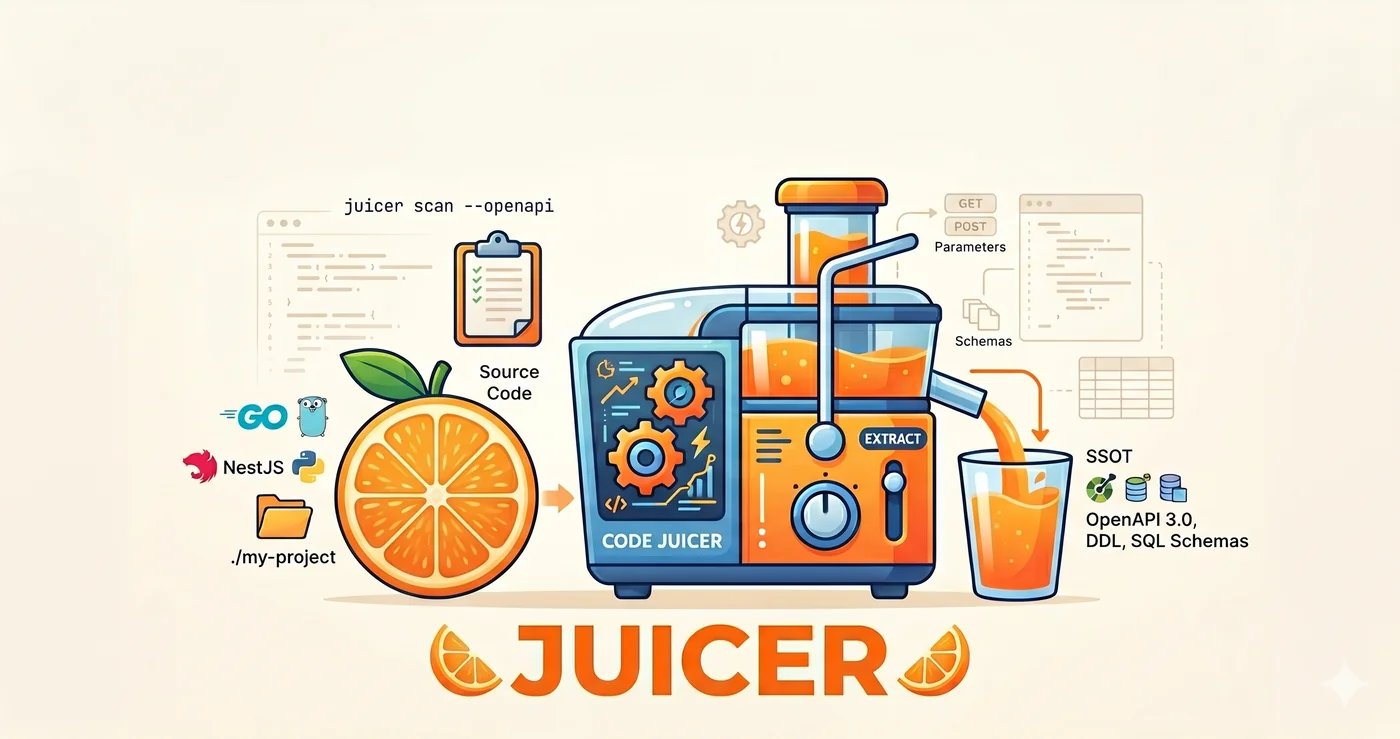
That is why juicer was built. It squeezes SSOT out of existing code.
Put the fruit in whole, juice comes out
juicer statically analyzes web framework source code to auto-extract declarative specs.
juicer scan --openapi ./my-project
This single line produces an OpenAPI 3.0 spec from existing code. What used to take days of manual work finishes in seconds.
Zero runtime overhead. No instrumentation needed. Pure static analysis. The same direction has been validated academically – Huang et al. (2024) presented Respector at ICSE, a technique for automatically generating OpenAPI specs from source code via static analysis alone.
Three frameworks
| Framework | Language | Extraction |
|---|---|---|
| Gin | Go | Routes, bindings, responses, middleware |
| NestJS | TypeScript | Decorators, DTOs, guards, interceptors |
| FastAPI | Python | Routes, Pydantic models, dependencies |
Go, TypeScript, Python – the three most widely used backend frameworks covered.
What it extracts
| Layer | Output |
|---|---|
| Routes | HTTP method, path, handler location, middleware |
| Request | Body binding type + struct fields, query/form/path params, file uploads |
| Response | Status codes, body type + struct fields, json/validate tags |
| OpenAPI | paths, parameters, requestBody, responses, components/schemas |
| DDL | Per-table CREATE TABLE snapshot from migration history |
| SQL | Repository method skeletons – CRUD type, table, params, return |
Decisions scattered across source code are condensed into declarative specs.
DDL consolidation
When 50 migration files have piled up, it is hard to tell what the current schema looks like. You have to mentally replay the accumulated ALTER TABLEs in order.
juicer ddl ./migrations -o ./schema
Reads the entire migration history and outputs one clean CREATE TABLE snapshot per table. 50 files become as many .sql files as there are tables.
sqlc query scaffolding
Extracts SQL query skeletons from code written with the repository pattern.
juicer sql next --repo ./repository --queries ./db/query
next – ratchet workflow. Shows the next repository method without a query, write the skeleton, move on. When all are filled, it stops.
juicer sql status
Shows current progress. Not the agent declaring “I’m done,” but the machine counting the remaining methods.
Entry into the yongol pipeline
juicer’s output is yongol’s input.
Existing code
  ↓ juicer scan --openapi
  ↓ juicer ddl
  ↓ juicer sql next
OpenAPI + DDL + sqlc queries
  ↓ yongol validate
  ↓ yongol generate
SSOT-based codebase
juicer reverse-extracts SSOT from existing code; yongol validates consistency and generates code. The transition from brownfield to greenfield doesn’t happen all at once but incrementally. Perry and Wolf (1992) defined architecture erosion and drift – violating the spec is erosion; becoming insensitive to the spec is drift. juicer is the tool that reverse-extracts specs from code where drift has already occurred, realigning them.
Start by feeding juicer’s OpenAPI and DDL to yongol. Run validate to expose cross-layer inconsistencies. Fix them one by one. Add SSaC. Add Rego. Add Hurl. At every step, yongol guarantees consistency.
Not foundation work but seismic retrofitting. Martin Fowler’s (2004) Strangler Fig pattern – don’t replace legacy all at once; wrap it incrementally. Reinforce the building without closing the store.
Get started
npx skills add park-jun-woo/juicer
juicer scan --openapi ./my-project
Existing code becomes juice.
Code: github.com/park-jun-woo/juicer
References
- Huang, R., Motwani, M., Martinez, I., & Orso, A. (2024). Generating REST API Specifications through Static Analysis. Proceedings of the IEEE/ACM 46th International Conference on Software Engineering (ICSE 2024). ACM
- Lercher, A., Macho, C., Bauer, C., & Pinzger, M. (2024). Generating Accurate OpenAPI Descriptions from Java Source Code. arXiv:2410.23873. arXiv
- Chauhan, S., Rasheed, Z., et al. (2026). OpenAI for OpenAPI: Automated generation of REST API specification via LLMs. Journal of Systems and Software. arXiv
- Perry, D. E. & Wolf, A. L. (1992). Foundations for the Study of Software Architecture. ACM SIGSOFT Software Engineering Notes, 17(4), 40-52. ACM
- De Silva, L. & Balasubramaniam, D. (2012). Controlling software architecture erosion: A survey. Journal of Systems and Software, 85(1), 132-151. ScienceDirect
- Fowler, M. (2004). StranglerFigApplication. martinfowler.com/bliki. Link
- Fritzsch, J., Bogner, J., Wagner, S., & Zimmermann, A. (2019). Microservices Migration in Industry: Intentions, Strategies, and Challenges. 2019 IEEE ICSME, pp. 481-490. arXiv
- Curino, C. A., Moon, H. J., & Zaniolo, C. (2008). Graceful database schema evolution: the PRISM workbench. Proceedings of the VLDB Endowment, 1(1), 761-772. VLDB
- Nghiem, D., Guo, H., & Foster, J. S. (2023). A Qualitative Study of REST API Design and Specification Practices. 2023 IEEE VL/HCC, pp. 148-156. IEEE
Related Posts
- yongol – The Keel of AI Coding SaaS – The tool that validates and generates code from SSOT extracted by juicer.
- Ratchet Pattern – How to Make Agents Finish the Job – Background of
juicer sql next’s ratchet workflow. - Reins Engineering – AI with Reins – The engineering framework juicer belongs to.